Non Traditional Black Women Reading Comp Lsat

Law school admissions decisions are often thought to exist formulaic and presume LSAT and GPA are the only important elements. We cannot deny that those numbers play a huge (and important) part in nigh admissions decisions. Simply, they aren't the only factors that thing. We've previously discussed other cardinal ingredients in the admissions determination factors, such as timing and applying through early on conclusion (ED). In that location are other factors that make a difference, and some of them are quantifiable factors with user-reported data. These include an applicant's gender, traditional or non-traditional status, and URM. In law school lingo, URM stands for an underrepresented minority. This postal service volition focus on statistics relating to how URM status may touch on law school application outcomes.
How Big of a Function Does Minority Status Play?
Theoretically, URM applicants may get a "boost," or increase chance of admission, due to their status every bit an underrepresented minority. There are a number of reasons and explanations for this, which become far across our purposes here. Merely, in general, law schools believe that creating a diverse environment means creating a rich environment. There is also evidence that the LSAT, while it generally creates a level playing field, may somewhat disadvantage certain racial and ethnic minorities. In addition, there are questions regarding structural problems with our public education organization that might disadvantage sure groups. Regardless of the reasoning for an URM boost, nonetheless, there is plenty of anecdotal testify to propose that information technology exists. The purpose of our analysis hither is to provide some numerical statistics to support that anecdotal evidence.
To address questions regarding any advantage URM candidates might have in law schoolhouse admissions, hither'due south what we need to practise:
- Quantify what we've termed the "URM Boost" by measuring the effects of URM status on admissions outcomes. We will too be controlling a variety of other quantifiable factors.
- Present the average LSAT and GPA figures for both URM and non-URM admits to schools in the USNWR Top 100. These schools have sufficient user-reported data available and thus make this equation more consistent.
This analysis makes use of data reported by law school applicants and spans the 2009/2010 through 2015/2016 application cycles. The URM condition for individual applicants was self-reported.
Does the URM heave exist?
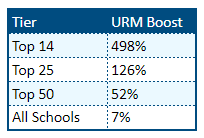
Short answer: aye! Almost every school we cover shows an increased chance of admission to URM applicants, with higher boosts for higher-tiered schools. Allow's review by tier. The number given in the table is the % increase in chances for admission for URM vs. non-URM candidates. We controlled for LSAT, GPA, applicant gender, ED application, non-traditional status, and the month an application was sent.
Equally you tin can run across in Table 1a, law schools typically give a 7% boost to URM applicants. In other words, a URM applicant who is exactly equal to a non-URM candidate, including all other factors nosotros command for, is 7% more than likely to be admitted to any law school than a not-URM equivalent. This number is a whopping 498% in the Superlative fourteen, 126% in the Acme 25, and 52% in the Superlative l police force schools.
From this data, we tin can conclude that URM applicants have a major reward during admissions decisions. That advantage is fifty-fifty higher in summit-tier schools.
The Acme 100 and the URM Heave
Table 1b below lists the 74 schools in the Top 100 for which we have enough data to depict conclusions. Information technology is ranked in order of the URM boost per centum. Schools shaded in xanthous demonstrated no statistically significant (NSS) discernible boost for URM applicants.
| Rank | School | URM Boost |
|---|---|---|
| 57 | Case Western | 36457% |
| 72 | Loyola (Chicago) | 25292% |
| six | NYU | 18728% |
| iv | Chicago | 18172% |
| 13 | Cornell | 13369% |
| 2 | Harvard | 10360% |
| 11 | Duke | 8336% |
| 4 | Columbia | 6707% |
| 3 | Stanford | 6069% |
| 16 | Vanderbilt | 5440% |
| 19 | USC | 4672% |
| l | Temple | 4172% |
| 14 | Georgetown | 3623% |
| 40 | Wake Forest | 2845% |
| 82 | Northeastern | 2829% |
| 40 | U of Colorado (Bedrock) | 1888% |
| 86 | Penn Land | 1795% |
| 86 | Chicago-Kent | 1731% |
| 65 | U of Connecticut | 1703% |
| 33 | U Wisconsin (Madison) | 1655% |
| 25 | George Washington | 1573% |
| 45 | U of Utah | 1572% |
| 15 | U Texas | 1564% |
| 40 | Washington & Lee | 1497% |
| 37 | Fordham | 1402% |
| 20 | Boston U | 1363% |
| 40 | U of Illinois | 1239% |
| 8 | UC Berkeley | 1117% |
| 12 | Northwestern | 1032% |
| 78 | U of Pittsburgh | 1000% |
| 28 | Boston College | 850% |
| 1 | Yale | 823% |
| 30 | Ohio State | 794% |
| 92 | Lewis & Clark | 698% |
| forty | U of Arizona | 668% |
| 17 | UCLA | 663% |
| 28 | U Alabama | 642% |
| 30 | William & Mary | 624% |
| 78 | American | 603% |
| 8 | UVA | 587% |
| 33 | U Georgia | 585% |
| xviii | WUSTL | 565% |
| 65 | Loyola Marymount | 557% |
| 25 | Arizona State | 528% |
| 7 | U Penn | 512% |
| 8 | Michigan | 490% |
| 25 | Indiana (Bloomington) | 435% |
| 38 | UNC | 371% |
| 45 | Southern Methodist | 363% |
| 74 | Cardozo | 359% |
| 33 | U Washington | 352% |
| 72 | Denver | 344% |
| 48 | U of Maryland | 335% |
| 30 | UC Davis | 321% |
| 86 | Syracuse | 294% |
| 50 | Hastings | 262% |
| 60 | U of Miami | 255% |
| 57 | Georgia State | 250% |
| 22 | Minnesota | 235% |
| 97 | Brooklyn | 230% |
| 50 | Houston | NSS |
| 22 | Notre Dame | NSS |
| 22 | Emory | NSS |
| 20 | Iowa | NSS |
| 45 | George Mason | NSS |
| 48 | U of Florida | NSS |
| l | FSU | NSS |
| fifty | Tulane | NSS |
| 55 | Baylor | NSS |
| 55 | Richmond | NSS |
| 60 | U of Kentucky | NSS |
| 65 | Pepperdine | NSS |
| 74 | U of San Diego | NSS |
| 100 | Michigan State | NSS |
Some of you might exist asking "Table 1a shows that for Top 50 schools every bit a whole, there is a 52% URM boost, but Tabular array 1b makes it await like that should be much larger!" It's a expert question but that disparity is explained past the fact that some schools accept no URM boost at all and the data is beingness sliced differently in each table.
In Table 1b, each school analyzes its applicants in a vacuum, without regard to other schools. In Table 1a, those applicants are grouped together within a tier. To put it differently, for the Tiptop xiv, Yale, Harvard, and Cornell students are all lumped together.
Yous have probably also noticed that many of the numbers in Table 1b are astronomical. Case Western gives URM applicants a 365-times better shot at admission? The takeaway here is that there are some URM admits whose numerical profiles (forth with other quantifiable admissions factors) simply would not have a shot if not for their URM status and other unmeasurable factors similar their personal statement, recommendations, resume, etc.
Don't read too much into any individual numbers in Table 1b. Instead, call up of it as a guideline that shows which schools requite relatively larger/smaller URM boosts.
LSAT Differentials
To brand things easier to digest, below are tables that show average LSAT and GPA scores for admitted URM students vs. non-URM students at the Top 100 schools. Beginning up, in Tabular array 2a, we are focusing on LSAT scores. The schools are listed by the divergence between an average not-URM admit's LSAT vs. the boilerplate URM admit's LSAT. Please note that nothing else is controlled for here, and these are just the raw numbers.
| Rank | School | Non-URM LSAT | URM LSAT | LSAT Differential |
|---|---|---|---|---|
| 4 | Columbia | 173.9 | 166.2 | seven.7 |
| 40 | Washington & Lee | 165.7 | 158.7 | seven.0 |
| 2 | Harvard | 174.iii | 167.5 | half dozen.8 |
| 4 | Chicago | 172.7 | 166.three | 6.4 |
| 57 | Case Western | 162.1 | 155.8 | 6.three |
| half dozen | NYU | 173.1 | 167.0 | vi.2 |
| 82 | Northeastern | 163.9 | 157.8 | 6.1 |
| 18 | WUSTL | 168.v | 162.vi | 5.nine |
| 8 | UC Berkeley | 171.6 | 165.9 | 5.7 |
| 12 | Northwestern | 171.v | 165.8 | 5.7 |
| eleven | Duke | 172.0 | 166.four | 5.6 |
| eight | Michigan | 171.0 | 165.4 | 5.6 |
| xl | U of Illinois | 166.5 | 160.9 | five.half-dozen |
| 7 | U Penn | 171.vi | 166.ane | 5.v |
| 72 | Loyola (Chicago) | 162.2 | 156.five | v.iii |
| 78 | American | 161.8 | 156.5 | 5.3 |
| xiv | Georgetown | 171.2 | 165.9 | 5.3 |
| sixteen | Vanderbilt | 169.viii | 164.6 | 5.2 |
| 28 | U Alabama | 166.3 | 161.1 | 5.1 |
| 38 | UNC | 164.9 | 159.8 | 5.1 |
| 3 | Stanford | 173.7 | 168.7 | 5.1 |
| 13 | Cornell | 170.two | 165.2 | 5.0 |
| ane | Yale | 175.0 | 170.0 | 5.0 |
| 33 | U Georgia | 166.4 | 161.5 | iv.9 |
| 92 | Lewis & Clark | 163.8 | 159.i | four.6 |
| 30 | William & Mary | 166.87 | 162.2 | iv.6 |
| 78 | U of Pittsburgh | 161.9 | 157.4 | 4.v |
| 15 | U Texas | 170.0 | 165.5 | 4.5 |
| 86 | Chicago-Kent | 162.0 | 157.6 | 4.four |
| 17 | UCLA | 170.0 | 165.vi | 4.3 |
| 45 | Southern Methodist | 164.5 | 160.2 | 4.three |
| 100 | Michigan Land | 159.0 | 154.seven | 4.3 |
| 25 | George Washington | 167.7 | 163.4 | 4.three |
| eight | UVA | 170.8 | 166.6 | four.3 |
| nineteen | USC | 169.one | 164.eight | 4.2 |
| 22 | Notre Dame | 166.9 | 162.seven | four.2 |
| 22 | Emory | 167.5 | 163.3 | iv.1 |
| 50 | Houston | 164.iv | 160.4 | 4.0 |
| 48 | U of Maryland | 163.4 | 159.4 | 4.0 |
| 86 | Syracuse | 157.five | 153.5 | 3.ix |
| 50 | Temple | 163.6 | 159.7 | 3.nine |
| 25 | Indiana (Bloomington) | 165.four | 161.5 | 3.9 |
| 33 | U Washington | 166.9 | 163.0 | 3.eight |
| thirty | Ohio Land | 164.3 | 160.5 | iii.8 |
| 33 | U Wisconsin (Madison) | 164.6 | 160.8 | 3.8 |
| 86 | Penn State | 161.seven | 158.0 | 3.8 |
| 74 | Cardozo | 164.5 | 160.8 | 3.8 |
| 50 | Hastings | 164.7 | 161.0 | three.seven |
| twenty | Boston U | 167.ane | 163.4 | 3.7 |
| 65 | U of Connecticut | 162.viii | 159.1 | 3.7 |
| 28 | Boston College | 166.seven | 163.1 | three.half-dozen |
| 40 | Wake Forest | 164.5 | 160.9 | 3.six |
| 97 | Brooklyn | 162.eight | 159.3 | iii.half-dozen |
| thirty | UC Davis | 165.6 | 162.2 | 3.iv |
| twenty | Iowa | 164.4 | 161.0 | 3.4 |
| 55 | Baylor | 163.half dozen | 160.three | iii.three |
| 37 | Fordham | 167.3 | 164.0 | three.2 |
| 45 | George Mason | 163.7 | 160.7 | 3.1 |
| 40 | U of Arizona | 163.4 | 160.5 | ii.ix |
| 60 | U of Kentucky | 160.7 | 157.8 | ii.9 |
| 22 | Minnesota | 167.6 | 164.7 | 2.nine |
| 48 | U of Florida | 163.3 | 160.six | 2.7 |
| 55 | Richmond | 162.4 | 159.7 | 2.vii |
| 40 | U of Colorado (Boulder) | 165.6 | 162.9 | 2.seven |
| 65 | Loyola Marymount | 163.5 | 160.9 | 2.5 |
| 25 | Arizona Country | 164.0 | 161.5 | two.v |
| 50 | Tulane | 163.0 | 160.6 | 2.5 |
| 45 | U of Utah | 163.i | 160.7 | 2.four |
| 72 | Denver | 160.9 | 158.8 | ii.ane |
| l | FSU | 162.5 | 160.five | 2.0 |
| 65 | Pepperdine | 163.4 | 161.6 | i.8 |
| 57 | Georgia State | 161.vii | 160.0 | one.7 |
| 74 | U of San Diego | 162.8 | 161.ii | 1.6 |
| threescore | U of Miami | 160.nine | 159.4 | 1.6 |
As you lot can come across, Columbia has the highest LSAT differential (by quite a bit, actually), with Columbia's differential being nigh five times college than the University of Miami'south, which is bringing up the rear. And, of grade, there is a wide range in between.
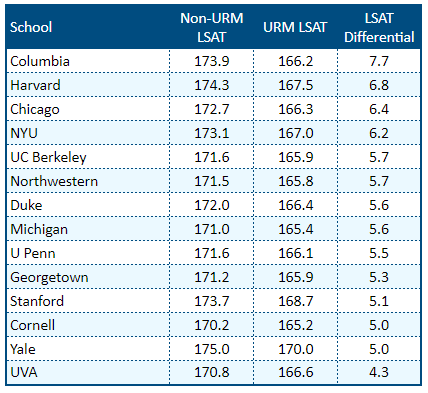
When comparing the Top 14 schools in Table 2b, the range is much smaller, but all the same considerable. Note that UVA's differential, despite being the lowest in Tabular array 2b, is however well inside the tiptop one-half for the 74 schools. This further underscores the idea that the URM heave is worth more at top schools.
GPA Differentials
In the following tables, we repeat the aforementioned exercise for GPA:
| Rank | School | Non-URM GPA | URM GPA | GPA Differential |
|---|---|---|---|---|
| 60 | U of Kentucky | 3.43 | 3.xx | 0.23 |
| 25 | Indiana (Bloomington) | 3.52 | iii.30 | 0.22 |
| 65 | U of Connecticut | 3.46 | iii.26 | 0.21 |
| 86 | Chicago-Kent | three.34 | 3.14 | 0.19 |
| l | Temple | three.48 | iii.29 | 0.19 |
| 40 | U of Illinois | iii.53 | iii.34 | 0.19 |
| 20 | Iowa | 3.59 | 3.40 | 0.nineteen |
| 92 | Lewis & Clark | 3.43 | iii.25 | 0.18 |
| 78 | American | 3.45 | 3.28 | 0.17 |
| 72 | Loyola (Chicago) | three.38 | three.21 | 0.17 |
| 97 | Brooklyn | 3.43 | iii.27 | 0.15 |
| 74 | Cardozo | 3.51 | iii.36 | 0.15 |
| 28 | Boston Higher | 3.62 | three.48 | 0.xv |
| 78 | U of Pittsburgh | 3.44 | 3.29 | 0.xv |
| 30 | William & Mary | 3.64 | three.50 | 0.xiv |
| 57 | Example Western | 3.41 | 3.27 | 0.xiv |
| 25 | Arizona State | three.55 | 3.41 | 0.14 |
| 86 | Penn State | 3.45 | 3.31 | 0.xiv |
| 45 | U of Utah | 3.l | three.37 | 0.13 |
| 74 | U of San Diego | 3.47 | 3.35 | 0.13 |
| 50 | Hastings | three.55 | 3.43 | 0.13 |
| half dozen | NYU | three.79 | three.66 | 0.13 |
| 2 | Harvard | 3.89 | three.76 | 0.12 |
| 22 | Minnesota | iii.53 | 3.41 | 0.12 |
| xxx | Ohio State | three.61 | 3.49 | 0.12 |
| 40 | Washington & Lee | iii.52 | 3.40 | 0.12 |
| 65 | Loyola Marymount | iii.52 | iii.41 | 0.12 |
| iv | Columbia | 3.79 | 3.68 | 0.12 |
| 28 | U Alabama | 3.53 | 3.41 | 0.12 |
| xv | U Texas | iii.71 | iii.60 | 0.11 |
| 3 | Stanford | iii.91 | iii.lxxx | 0.11 |
| 16 | Vanderbilt | iii.70 | 3.59 | 0.11 |
| 4 | Chicago | 3.85 | 3.74 | 0.xi |
| xiii | Cornell | 3.75 | 3.64 | 0.xi |
| seven | U Penn | three.82 | 3.71 | 0.11 |
| xix | USC | 3.74 | iii.64 | 0.x |
| 57 | Georgia State | 3.47 | 3.36 | 0.x |
| 33 | U Wisconsin (Madison) | 3.48 | 3.38 | 0.ten |
| 40 | U of Arizona | 3.52 | three.42 | 0.10 |
| ane | Yale | iii.52 | iii.42 | 0.x |
| 100 | Michigan State | 3.48 | 3.39 | 0.10 |
| 8 | UC Berkeley | 3.84 | three.75 | 0.09 |
| 12 | Northwestern | 3.68 | 3.59 | 0.09 |
| twoscore | U of Colorado (Boulder) | iii.54 | iii.45 | 0.09 |
| 20 | Boston U | iii.67 | iii.58 | 0.09 |
| 40 | Wake Wood | 3.50 | 3.42 | 0.09 |
| 48 | U of Maryland | 3.47 | 3.39 | 0.09 |
| 8 | Michigan | iii.74 | iii.66 | 0.08 |
| 11 | Knuckles | 3.79 | iii.71 | 0.08 |
| 65 | Pepperdine | three.55 | iii.47 | 0.08 |
| 86 | Syracuse | iii.36 | 3.28 | 0.07 |
| 33 | U Washington | iii.65 | three.58 | 0.07 |
| 14 | Georgetown | 3.71 | 3.64 | 0.07 |
| 22 | Notre Matriarch | 3.63 | 3.57 | 0.06 |
| 55 | Richmond | 3.40 | three.33 | 0.06 |
| xviii | WUSTL | 3.54 | 3.48 | 0.06 |
| 37 | Fordham | 3.61 | 3.55 | 0.06 |
| 45 | George Mason | three.50 | 3.44 | 0.06 |
| 55 | Baylor | 3.48 | three.42 | 0.06 |
| 82 | Northeastern | 3.48 | 3.42 | 0.06 |
| 30 | UC Davis | three.61 | three.55 | 0.06 |
| 72 | Denver | 3.37 | 3.32 | 0.06 |
| 8 | UVA | iii.74 | iii.68 | 0.06 |
| 38 | UNC | three.56 | 3.51 | 0.05 |
| 25 | George Washington | 3.61 | three.56 | 0.05 |
| 60 | U of Miami | 3.45 | iii.twoscore | 0.05 |
| 50 | Tulane | three.45 | iii.45 | 0.05 |
| 17 | UCLA | iii.73 | iii.74 | -0.01 |
| 50 | FSU | 3.47 | 3.50 | -0.03 |
| 22 | Emory | 3.58 | iii.62 | -0.04 |
| 45 | Southern Methodist | three.45 | 3.51 | -0.06 |
| 33 | U Georgia | 3.49 | 3.56 | -0.07 |
| 50 | Houston | 3.44 | 3.53 | -0.x |
| 48 | U of Florida | iii.55 | iii.66 | -0.11 |
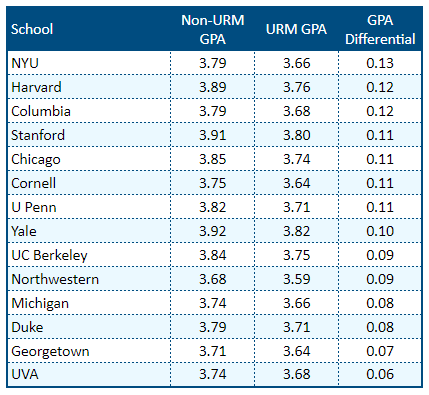
Here, nosotros see a range of differentials, this time for the GPA. You tin see that for 7 schools, admitted URMs had a higher average GPA than admitted non-URM applicants. Admittedly, some of that may have to do with smaller sample sizes for URM applicants that may not be entirely representative. Regardless, this gives y'all a general thought of where the schools stand in terms of the divergence in the GPAs of URM and non-URM admitted students.
While a lot tin can be said or debated about these numbers, 1 thing for sure is that when information technology comes time for constabulary schoolhouse applications. Students who tin use as underrepresented minorities do seem to accept an advantage. For those students, each additional LSAT signal (or tenth of a point of GPA) can exist that extra edge needed to get into a schoolhouse.
Final notation: Some of the information used here comes from public, self-reported sources. Thus information technology tin be bailiwick to some variation and dubiousness. Please continue this in mind when reviewing specific outcomes, and recollect that each year the numbers can and exercise change.
Non Traditional Black Women Reading Comp Lsat
Source: https://blog.powerscore.com/lsat/do-underrepresented-minority-urm-applicants-have-a-law-school-admissions-advantage/
0 Response to "Non Traditional Black Women Reading Comp Lsat"
Post a Comment